|
Compartir
By Diego Dalai
November 1, 2012
For years, the international economic crisis has been exerting pressure on the local economy, mainly through falling nickel prices (the country’s second-largest foreign-currency income), the increase in food prices (Cuba must import 80% of the food that it consumes, and this is the main expenditure in dollars that it has to make), and scarcity of credit. What has prevented the economy from collapsing, from 2008 until now, is the financing in various ways that Venezuela (the biggest economic partner since 2003) gives Cuba.
In the first place, oil at a bargain price, that covers 50% of the national demand. And, in second place, paying professionals in health care and education (there are some 30,000 Cuban professionals in Venezuela) for services.
China has been the other big commercial partner (the second-largest since 2006). It provides Cuba with products, machinery (bicycles, busses, electrical appliances) and spare parts. At the same time, it has become the main buyer of nickel (of which Cuba is the biggest exporter in the world), and a key investor in this key sector of the local economy. To a lesser extent, although more important strategically, has been the entry of Brazilian capital, mainly in investments in the port of Mariel (a few kilometers from Havana), and in products of little “value added,” like biocombustibles (despite the rhetoric Fidel once had against this modern economic branch).
Austerity against the workers
Next to this, since 2008, Raúl Castro’s government has undertaken a series of reforms and austerity measures that have contributed to avoiding economic collapse. From the strictly financial point of view, he reduced the huge fiscal deficit through elimination of subsidies in several sectors of the economy and by detaching some activities that passed from the state to the private (self-employed) sector, a big reduction of the ration book (that would cover about a third of the monthly needs of a typical family) and the laying off of tens of thousands of government workers (the original plan was to fire 500,000 employees up to 2013, but it had to be “revised” by postponing its application, because of the discontent that it was creating among broad groups).
In order to avoid economic paralysis and hundreds of thousands of inhabitants’ falling into poverty, the development of self-employed activities on a scale never seen since 1959 was encouraged. The economic activities (trades) authorized for self-employed work jumped from some few dozens to almost 200. The slightly more than 100,000 Cubans that were engaging in this kind of independent work tripled, exceeding the 300,000 that are now legally authorized to practice any type of profitable activity. The selling of products for construction wholesale, outside of the state-owned stores, was allowed, and the hiring of employees was legalized. Since 2010, the handing over (leasing, that is, formally keeping state ownership) of idle productive lands to individual farm laborers, has begun. This process continues to be intensified, creating a prosperous layer of farm laborers, that tends to enrich itself and is pressing for more market reforms, at the same time that it gradually intertwines with the bureaucracy as necessary partners.
All this has given a certain dynamism to the most prosperous groups in society, especially those with access to dollars, that allows them a certain small-scale investment for this type of activities.
Latin America
The government of Evo Morales is responding to the third day of COB* strikes and blockades with repression and McCarthyist discourse.
More than 500 people attended the presentation of the book "Lenin: Selected Works"(Lenin, Obras Selectas), which took place at the Feria Internacional del libro in Buenos Aires.
The election of the businessman Cartés as the new President of Paraguay in some elections that legitimize the parliamentary coup that removed Lugo from office on June 22, represents a political victory for the most concentrated groups of the bourgeoisie and imperialism. After Maduro’s weak victory in Venezuela, Cartés’ success gives a certain encouragement to the political right wing of the Southern Cone.
Workers Movement
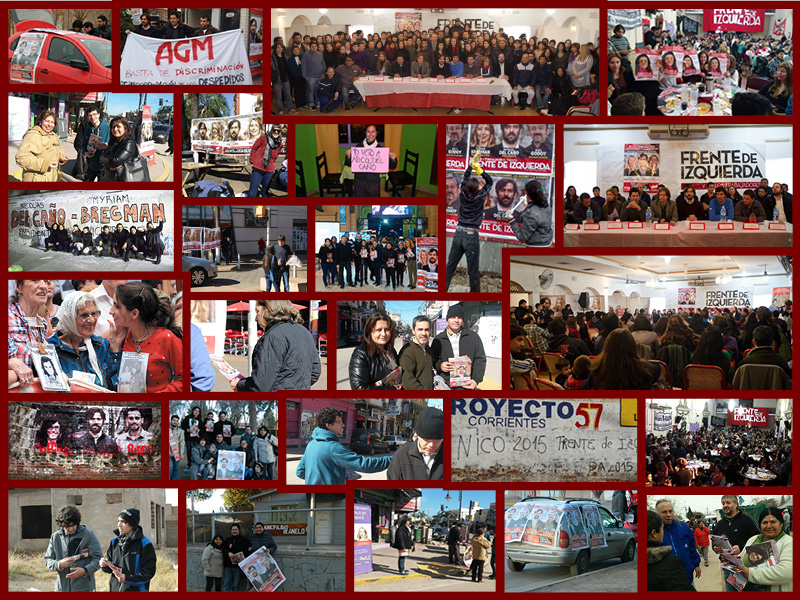
On April 21, the Left and Workers’ Front submitted a bill in the Neuquén provincial parliament proposing that no member of parliament or state official should earn more than a teacher with 20 years’ service.
On April 21 and 22, the election for the shop stewards committee at the Coca-Cola plant in Pompeya, Buenos Aires city, took place. The rank-and-file list, called Lista Marrón (Brown List) was backed by 43% of the workforce in a 93% turn out. The Lista Verde (Green List), backed by the union leadership, came second, and a split from the Green List came third. The plant has 609 workers and we spoke with two members of the newly elected shop stewards committee.
Other Articles
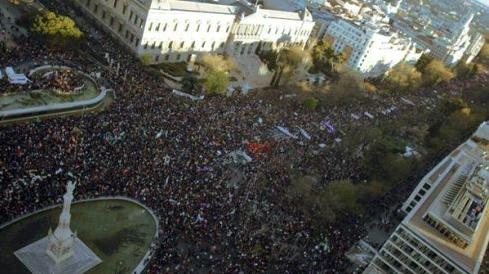
Doctors, teachers, firefighters, workers from the private sector, unemployed workers, and students, yelling “Against the coup d’état by the markets, we owe nothing, we’re not paying,” demonstrated in more that 80 Spanish cities, with the support of more than 300 organizations.
On Thursday, February 21, Juan Pablo Jiménez Garrido, President of Union Number 1 of the electrical engineering firm Azeta, and President of the Federation of Workers of Azeta, a subcontracting firm of Chilectra , was found murdered in his workplace, from a bullet in the head.
The most recent information about the Bárcenas case, published by El País exposes still further the real nature of the political regime born from the Transition and all its institutions.
Democratic Rights
An unexpected and closed election result shook the country and has put the national situation in suspense. Nicolás Maduro hardly exceeded the candidate of the rightwing opposition...
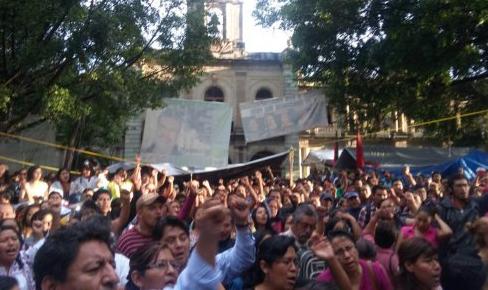
The PRI government, headed by current president Enrique Peña Nieto, is pushing to impose, at all costs, an educational reform that seeks to advance the privatization of education.
Christian Castillo, national leader of the PTS (Partido de Trabajadores Socialistas), made a statement after floods caused chaos in parts of Buenos Aires City and Buenos Aires province.
For a revolutionary constituent process.
For a working-class and socialist solution to the crisis
A speech by Vincent Duse, a militant of the CGT in the Peugeot Mulhouse plant and a member of the Revolutionary Communist Current (in the NPA) of France
When the news item became known, in Brixton (a neighborhood in South London), in Glasgow (Scotland), and certainly in more than one miners’ town, many people went out to the street by way of celebration.
Cuba
For years, the international economic crisis has been exerting pressure on the local economy, mainly through falling nickel prices (the country’s second-largest foreign-currency income), the increase in food prices (Cuba must import 80% of the food that it consumes, and this is the main expenditure in dollars that it has to make), and scarcity of credit. What has prevented the economy from collapsing, from 2008 until now, is the financing in various ways that Venezuela (the biggest economic partner since 2003) gives Cuba.
After his cynical and provocative passage through the Mexico of the murders of women and homophobia, Pope Joseph Ratzinger, the highest representative of the Catholic Church, a close ally of imperialism and the most reactionary and obscurantist institution on the planet, arrived in Cuba...
Official rhetoric insists that "53 years after the victory of the Revolution, Cuba is absorbed in modernizing its economic model, a process designed to guarantee the continuity and strengthening of the socialist system adopted by the Island"...
The Trotskyist Fraction - Fourth International (TF-FI) consists of the
PTS (Partido de los Trabajadores Socialistas/ Socialist Workers Party), from Argentina, the LTS-CC (Liga de Trabajadores por el Socialismo – Contracorriente/ Workers League for Socialism – Against the current), from México, the
LOR-CI (Liga Obrera Revolucionaria por la Cuarta Internacional/ Revolutionary Workers League - Fourth International), from Bolivia, LER-QI (Liga Estrategia Revolucionaria/ Revolutionary Strategy League - Fourth International), from Brazil, PTR-CcC (Partido de Trabajadores Revolucionarios/ Revolutionary Workers Party), from Chile, LTS (Liga de Trabajadores por el Socialismo/ Workers League for Socialism) from Venezuela, LRS (Liga de la Revolución Socialista/ Socialist Revolutionary League), from Costa Rica, CcC (Clase Contra Clase/ Class against Class), from the Spanish State, TF-FI supporters in Uruguay, RIO Group, supporting section in Germany and TF militants in the CCR/Plateforme Z du NPA (Nuveau Parti Anticapitaliste)/ Platform Z NPA (New Anticapitalist Party) from France.
You can contact us by e-mail at: contacto@ft-ci.org